The veggie burger that actually holds together on the grill — and why most homemade versions fall apart before they even hit the plate
I have made a lot of bad veggie burgers. Not a few — a lot.
Patties that looked perfect in the bowl and dissolved on contact with the grill. Patties that held together in the pan but turned to paste in the bun. Patties that were structurally sound but tasted of nothing except the effort it took to make them.
Every failure taught me something, and after enough rounds of testing I now make a veggie burger that I would put against anything — one that holds its shape on the grill, develops a proper crust, and tastes like something you actually wanted to eat rather than something you settled for.
The reason most homemade veggie burgers fall apart is not a mystery, and it is not down to bad luck or the wrong recipe. It is almost always one of three things: too much moisture in the base ingredients, the wrong binder ratio, or skipping the chilling step that lets the patty firm up before it hits heat.
Fix those three things and you fix the burger. Everything else is flavour, which is the part I enjoy most.
Vegetarian grilling is something I am genuinely passionate about — not as a workaround or a consolation prize, but as a cooking discipline that is massively underrated and poorly understood by most people who grill. A veggie burger done properly is not a substitute for a meat burger. It is its own thing, with its own texture logic and its own set of techniques, and it deserves to be treated that way.
Why moisture is the enemy
Most vegetarian burger bases — beans, lentils, cooked grains, mushrooms, grated vegetables — contain a significant amount of water. That water is the main reason home cooks end up with a patty that disintegrates the moment it touches a hot surface.
The heat from the grill or pan turns that moisture to steam almost immediately. Steam pushes outward from the inside of the patty, which breaks down whatever structure you built in the mixing stage. You end up with something that is simultaneously too wet in the middle and scorched on the outside, and there is no recovering from it once it has happened.
The fix starts before you mix anything. If you are using beans — black beans, chickpeas, or kidney beans — drain them thoroughly and then spread them on a clean tea towel and pat them completely dry. Let them sit for a few minutes. You want the surface moisture gone before they go into the bowl.
If you are using mushrooms, cook them first in a hot dry pan until their moisture has fully evaporated and they are concentrated and slightly chewy. Grated vegetables like carrot or beetroot should be salted, left for ten minutes, then squeezed hard in a clean cloth. You will be surprised how much liquid comes out.
This step alone will change the outcome more than any other single adjustment you can make.
The binder ratio that actually works
Once your base ingredients are properly dried out, you need a binder that holds everything together without making the patty dense or gluey. The combination I have tested most and trust most is one egg plus two to three tablespoons of breadcrumbs per roughly four hundred grams of base mixture.
The egg provides the initial binding — the protein coagulates when heated and sets the structure of the patty. The breadcrumbs absorb residual moisture during cooking and give the burger a slightly firmer interior texture that holds up when you bite into it. Too many breadcrumbs and the patty tastes dry and starchy. Too few and you lose the structural benefit entirely.
If you want to keep it egg-free, a flax egg — one tablespoon of ground flaxseed mixed with three tablespoons of water, left for five minutes to gel — works reasonably well, though the patty will be slightly more fragile and benefits even more from the chilling step. A tablespoon of tahini or nut butter also adds binding quality along with fat, which improves both texture and flavour.
One thing to avoid: adding flour directly to the mixture as a binder. It creates a gummy interior that never quite cooks through properly, and it dulls every other flavour in the patty.
Chilling is not optional
This is the step that most recipes mention briefly and most home cooks skip, and it is the reason the grill version of a veggie burger has a reputation for being difficult. After you have mixed the patty and formed it into shape, it needs to rest in the fridge for a minimum of thirty minutes — ideally an hour, and if you make them the night before, even better.
During that rest, the binder has time to set, the breadcrumbs absorb any remaining moisture, and the whole patty firms up into something that will hold its shape under heat rather than slumping the moment it leaves your hands. Think of it the same way you think about resting dough or marinating protein — the time is doing structural work that you cannot shortcut.
When I am teaching my nephews how to grill — which I do whenever I get the chance, because I think it is a skill worth learning properly from the start — this is the point I make most firmly. Make the patties in the morning. Put them in the fridge. Come back to them when the grill is hot. The waiting is part of the process.
The base mixture that works on the grill
After a lot of testing, this is the combination I come back to most consistently because it delivers on texture, flavour, and structural integrity simultaneously.
Start with one tin of black beans, drained and dried thoroughly as described above, then roughly mashed — not puréed, you want some texture remaining. Add one hundred grams of cooked brown rice that has been spread on a tray and left to cool and dry out slightly.
Add one small carrot grated and squeezed dry, two tablespoons of finely diced red onion, one clove of garlic grated in, one teaspoon of smoked paprika, one teaspoon of cumin, half a teaspoon of coriander, a good pinch of salt, and a few cracks of black pepper. Add one egg and two tablespoons of panko breadcrumbs.
Mix until everything is combined and the mixture holds together when you press a small amount between your fingers. If it feels wet, add another tablespoon of breadcrumbs. Form into four patties about two centimetres thick — thinner than you think you need, because they will puff slightly on the grill. Press a small indent into the centre of each with your thumb to prevent doming. Refrigerate for at least an hour.
How to grill them without losing them through the grates
A grill is less forgiving than a cast iron pan, and that is exactly why getting the grill version right matters to me. A pan will catch a patty that starts to slip. A grill will not, and a veggie burger that falls through the grates is a particular kind of cooking defeat.
The grill needs to be properly hot before the patties go on — not warm, hot. A hot grill sears the exterior of the patty on contact, which creates an immediate crust that provides structural support from the outside. A cool or warm grill lets the patty sit in indirect heat and steam from underneath, which is how you end up with something grey and collapsing.
Brush the grill grates generously with a neutral oil immediately before the patties go on. Brush the patties themselves with a little oil on both sides. Place them on the grill and leave them completely alone for four to five minutes. Do not press them, do not nudge them, do not check underneath. When the patty releases cleanly from the grate on its own — when it no longer sticks — it is ready to flip. If it is still holding on, it needs another minute.
One flip only. Flip it once, leave it for another four minutes, and it is done.
The toppings that complete it
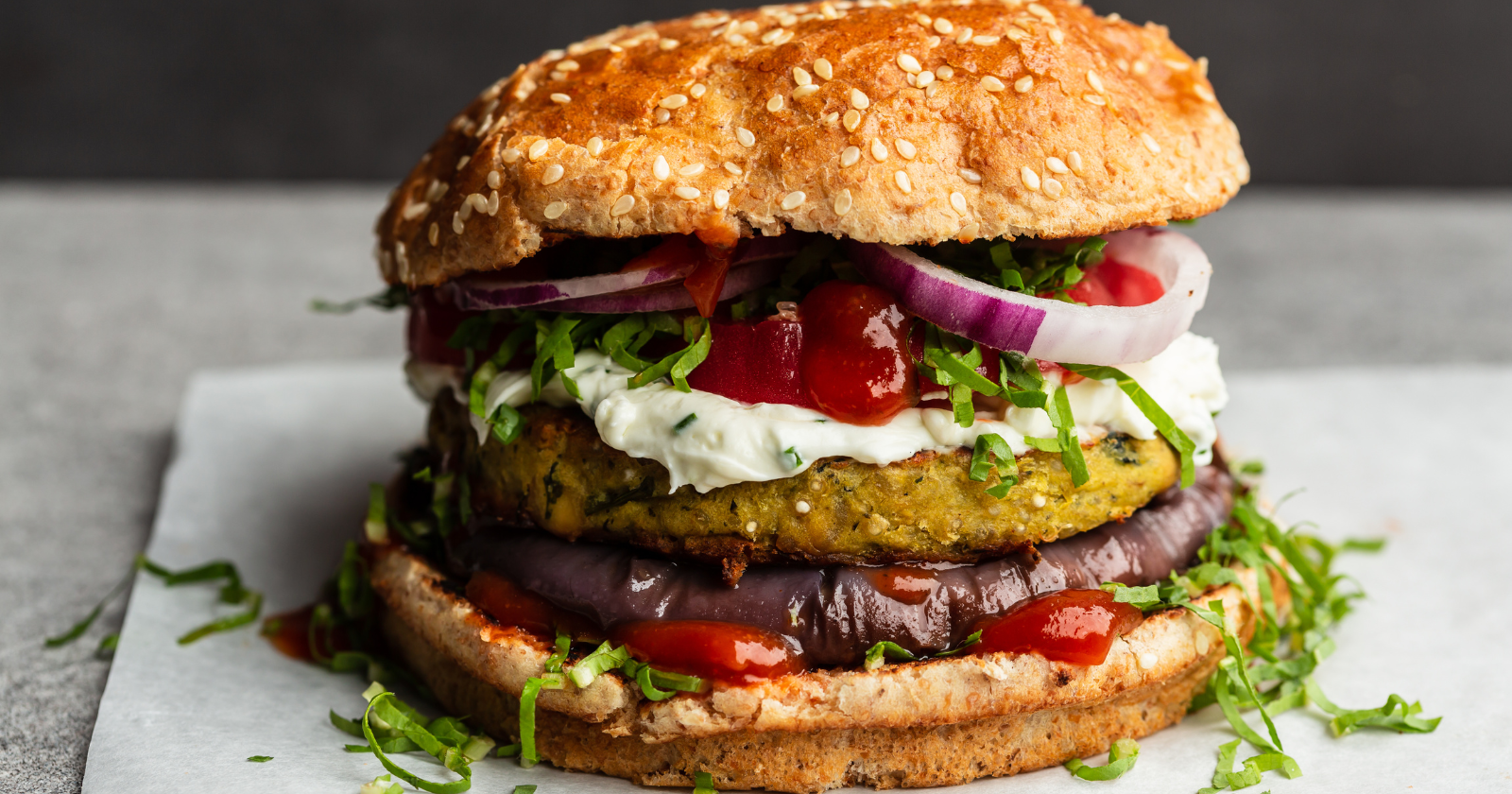
A burger this good deserves toppings that add to it rather than cover it up. I keep it straightforward: a smear of chipotle mayo on the bottom bun, the patty, a slice of sharp cheddar melted on in the last minute of grilling with the lid closed, thinly sliced pickled jalapeños, a few leaves of crisp cos lettuce, and a thick slice of tomato that has been salted for a few minutes so it seasons itself.
The pickled jalapeños are doing the same job that good pickles always do on a burger — cutting through the richness of the cheese and the fat of the mayo with acidity and heat. Without them, the whole thing becomes one long note. With them, every bite has something happening.
That contrast is what a good burger is, vegetarian or otherwise. Get the structure right, season it properly, grill it with patience, and finish it with something sharp. The rest takes care of itself.